Near-death
A Man Says He Was Dead for 45 Minutes. Stephen Never Came Back to Tell Us — But He Told Us Anyway.
August 7, 2026 · relevantmagazine.com
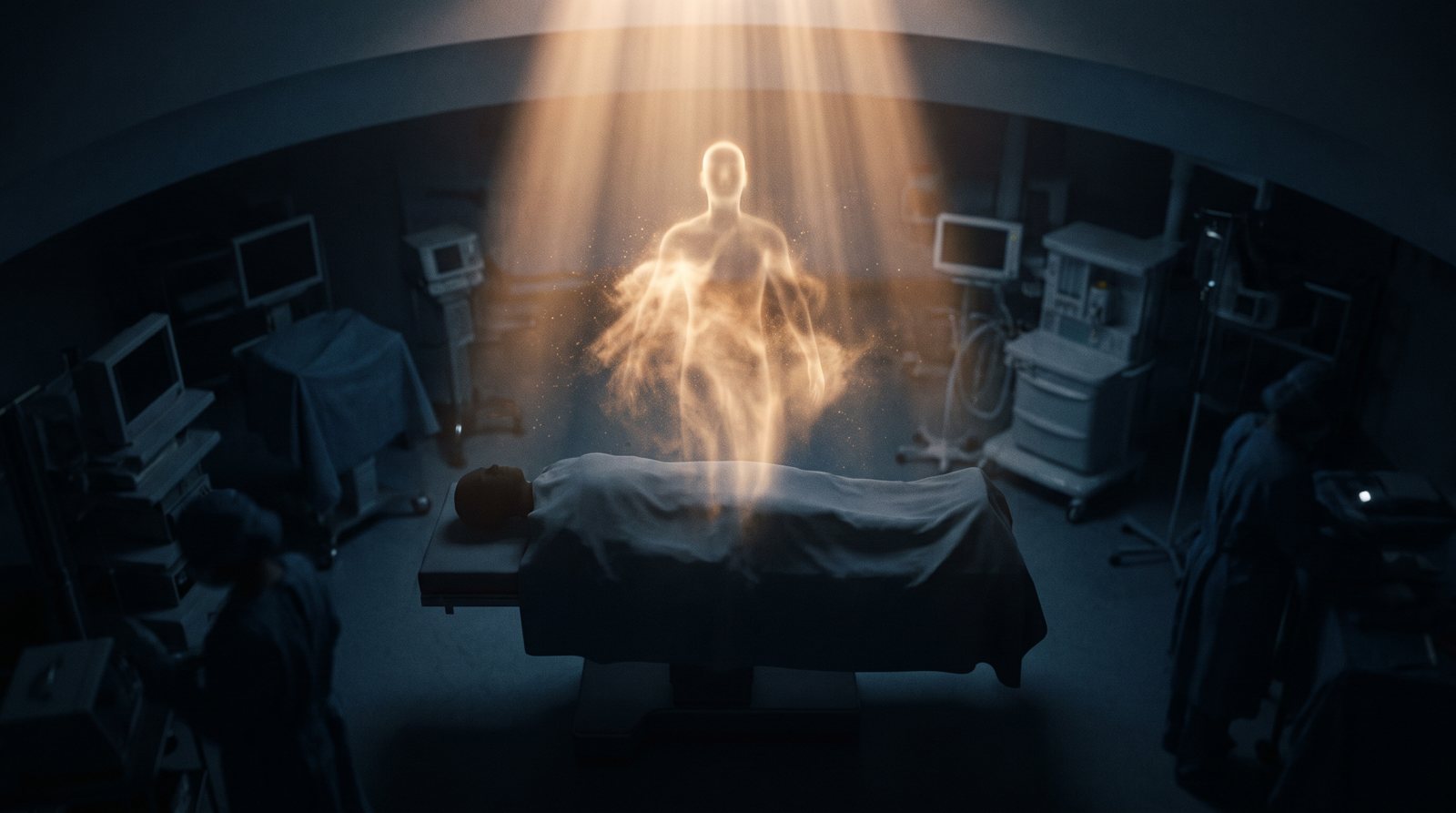
Mike McKinsey went into the hospital with a fever and a pain in his side. The doctors suspected appendicitis. During the examination the pain turned severe, and he was taken into emergency surgery.
What he says happened next is that he died — and that he was gone for forty-five minutes.
He describes standing on green grass under a light too bright to account for. Flowers in colors he calls pastel. A city off in the distance with golden domes and white steeples. Tubes of light coming down and striking his forehead, and with them a warmth and a peace he has not been able to put down since.
And a figure, walking toward him.
"Even though he looked different," McKinsey says, "I knew immediately that it was Jesus."
What the figure said to him was this: *"I want to answer your prayer."*
McKinsey is a construction superintendent in Chattanooga, Tennessee. He is not a minister. He is not selling a book. His account was reported by the *International Business Times UK*, and it has traveled the way these stories travel — fast, and passed hand to hand by people who found something in it.
One note, briefly, because we would rather you heard it from us than found it later. The outlet that carried the story says plainly that the medical particulars "have not been independently verified through publicly available hospital records." No hospital named, no physician named. So what you have is Mike McKinsey's testimony, and we are handing it to you as exactly that — a man's account of what happened to him. Which is what testimony has always been, and how every account in this article reached us, including the ones that are in your Bible.
That is what happened.
Now: is there a single reason on earth to take it seriously?
There is considerably more than most people know.
II. THE WEIGHING
Everything above is the account as it was reported. What follows is our weighing of it, and it is all evidence. We start with the laboratory, because that is the part a skeptic can check without granting us anything at all. We end with Scripture, because we hold it to be the best evidence there is — and this site declares that rather than smuggling it in.
The dying-brain explanation is in serious trouble
For most of the last century the working answer was simple. A dying brain misfires, and the person hallucinates on the way out. Comforting chemistry, nothing more.
That answer is now in trouble — and it is not believers who put it there. It is cardiologists and neuroscientists with monitoring equipment running.
In 2023 a team led by Dr. Sam Parnia published AWARE-II in the journal Resuscitation. Seven years of work. Twenty-five hospitals across the United States and the United Kingdom. 567 patients who went into cardiac arrest while already admitted.
The design is the whole point. Instead of interviewing survivors years afterward, when memory has had time to rearrange itself, the team ran EEG and cerebral oxygen monitoring during resuscitation — while CPR was actually in progress. They were recording the brain at the exact moment in question.
Of the 567 arrests, 53 patients survived. Twenty-eight were well enough to be interviewed. Eleven of them reported memories or perceptions from the period they were being resuscitated — roughly one in five describing what researchers classify as a recalled experience of death: a consistent, structured pattern, not a jumble. Around 40% reported some awareness they could not put into words. (That interview group is 28 people. We would rather give you the denominator than quote a percentage without it.)
Then comes the part that is genuinely hard to explain.
Eighty-five patients had EEG running throughout. In nearly 40% of them, brain activity returned to normal or near-normal patterns at points as far as an hour into CPR — gamma, delta, theta, alpha and beta rhythms. Gamma in particular is the signature associated in ordinary life with focused attention and memory retrieval.
This is a brain that, by the old explanation, should have been dark. Parnia's conclusion was not hedged: "These lucid experiences cannot be considered a trick of a disordered or dying brain."
A second laboratory, arriving from the opposite direction
Jimo Borjigin, a neuroscientist at the University of Michigan, documented a surge of gamma activity in dying rats in 2013. In 2023, in the Proceedings of the National Academy of Sciences, her team reported the same phenomenon in dying human beings: of four comatose patients removed from life support, two showed dramatic gamma oscillations — concentrated in the temporal-parietal junction, the region that integrates perception and constructs the sense of a self located somewhere.
"Just before death," she put it, "the brain is hyper-activated."
Two labs. Different methods, different subjects, no shared agenda, no theological stake. The same anomaly.
And the people never go back to who they were
Bruce Greyson, professor emeritus of psychiatry at the University of Virginia and a founder of its Division of Perceptual Studies, has spent roughly fifty years collecting these accounts and built the scale most researchers now use to score them.
What he documents is less about what people saw than about who they became afterward. One survey he cites — Cassandra Musgrave's, in 1997, of 51 experiencers — found definite belief in an afterlife rising from 22% before to 92% after. Small sample, and we will not oversell it. But the wider literature keeps landing in the same place: the fear of death drops away and does not return, and the change holds for the rest of the person's life.
How many people are we talking about? The largest formal archive holds more than 5,000 submitted accounts. Population estimates run vastly higher — Gallup polling in the early 1990s supported estimates of 12 to 15 million Americans. Thousands carefully collected. Millions plausibly experienced.
And one detail turns up so relentlessly that it has become a finding in its own right. Asked to describe what happened, people cannot do it:
"I can't tell you what happened. There are no words for it."
Hold onto that sentence. It is about to appear somewhere you are not expecting it.
What the evidence does and does not establish
Let us be careful here, because carelessness is what kept serious people away from this subject for forty years.
The research establishes that something real happens at the edge of death; that it is lucid rather than confused; that it is remembered in detail; that it occurs while the brain is doing things the textbooks say it cannot do; and that it permanently changes the person it happens to.
What the research does not do is name the figure walking toward Mike McKinsey. It cannot. That is not a thing an electrode can measure, and any scientist claiming otherwise would have left his instruments behind.
So the monitors carry us to the threshold and stop.
Who we believe is standing there
Here is where we tell you plainly where we stand.
We believe the figure is Christ. Not as one interpretation among several on offer. Among the thousands of collected accounts are a great many from people with no Christian background and no expectation of one — skeptics, the unchurched, the openly hostile — who describe meeting a Person they did not anticipate and could not place, and who spent the years afterward arriving at the same name Mike McKinsey arrived at on the table. A dying brain assembling comfort out of stored belief ought to hand a man back what he already had. It keeps handing people what they never had and did not want.
That is our reading, offered as a reading. What follows is not.
There is a veil, and Scripture says so plainly
Start with the thing modern people find hardest to accept and Scripture simply assumes: the world you can see is not all of the world that is there.
"While we look not at the things which are seen, but at the things which are not seen: for the things which are seen are temporal; but the things which are not seen are eternal." — 2 Corinthians 4:18
Read what Paul takes for granted in that sentence. There is a whole order of things that is unseen and permanent, standing behind an order of things that is visible and passing away. The invisible is not the thin part of reality. It is the durable part. What we can see is the layer that is going.
And our access to it, right now, is deliberately limited:
"For now we see through a glass, darkly; but then face to face: now I know in part; but then shall I know even as also I am known." — 1 Corinthians 13:12
Now — through smoked glass, in outline, guessing. Then — face to face. Paul is not describing a defect in some people's faith. He is describing the standing condition of every living human being. There is a barrier, we are all on this side of it, and the limitation is on our perception rather than on what is actually there.
Which raises the obvious question. If the unseen realm is real and constant and just beyond a membrane, what would it take for a person to see it?
Scripture answers that too, in the strangest rescue in the Old Testament.
Elisha's servant, and the army that was already there
The city of Dothan is surrounded overnight. Elisha's servant walks outside at dawn, sees the horses and chariots of a hostile army ringing the walls, and panics.
"And his servant said unto him, Alas, my master! how shall we do? And he answered, Fear not: for they that be with us are more than they that be with them. And Elisha prayed, and said, LORD, I pray thee, open his eyes, that he may see. And the LORD opened the eyes of the young man; and he saw: and, behold, the mountain was full of horses and chariots of fire round about Elisha." — 2 Kings 6:15–17
Notice the order of events, because everything depends on it.
Elisha says "they that be with us are more than they that be with them" before anything is revealed. He is not making a prediction. He is stating a present fact about a mountainside that already, at that moment, holds horses and chariots of fire. The servant is standing in the middle of it and cannot see it.
Then the prayer. And notice what Elisha does not ask for. He does not ask God to send the chariots. He does not ask God to open heaven, or to part anything, or to alter the situation in any way at all. He asks God to open the boy's eyes.
Nothing about the mountain changed. Something about the young man did.
That is the doctrine of the veil in one scene: the unseen realm is not far away and not occasional. It is here, it is populated, and it is nearer than the threat you are looking at. We walk through it every day of our lives without perceiving it — not because it is absent, but because our eyes are shut to it while we are in this body and in this age.
And if perception is the barrier rather than distance, then the barrier is exactly the sort of thing that could give way at the moment the body does.
Christ did not thin the veil. He tore it.
Here is where the Christian account parts company with every vague spirituality that talks about thin places and open doors.
The veil is not a mood, and it does not fluctuate. It was a real curtain in a real building, hanging between the people and the Holy of Holies, and its whole purpose was to keep sinful men out of the immediate presence of a holy God. It was a "No."
Then this happened:
"Jesus, when he had cried again with a loud voice, yielded up the ghost. And, behold, the veil of the temple was rent in twain from the top to the bottom; and the earth did quake, and the rocks rent." — Matthew 27:50–51
Two details are doing enormous work.
It tore at the instant He died. Not the following morning, not at the resurrection. The moment the atonement was finished, the barrier failed.
It tore from the top to the bottom. No man reached that height. It was opened from the other side — from God's side, downward, toward us. Nobody broke in. Someone opened it.
The letter to the Hebrews states exactly what was purchased:
"Having therefore, brethren, boldness to enter into the holiest by the blood of Jesus, by a new and living way, which he hath consecrated for us, through the veil, that is to say, his flesh." — Hebrews 10:19–20
Read the last clause slowly. The veil, that is to say, his flesh. The curtain was never merely fabric; it stood for Christ Himself as the only way to the Father. His body torn is the curtain torn. The way through the barrier is a Person, and it cost Him His life to become it.
The scholar G. K. Beale argues that the rending signals "both a cosmic and cultic reality: the inbreaking destruction of the old creation and inauguration of the new creation, which introduces access for all believers to God's holy presence in a way that was not available in the old creation." That is not a metaphor being stretched. It is the structure of reality being altered at a particular hour on a particular Friday.
And the consequence is offered to ordinary people, now, without dying first:
"Let us therefore come boldly unto the throne of grace, that we may obtain mercy, and find grace to help in time of need." — Hebrews 4:16
Boldly. To the throne. That word would have been unthinkable on the other side of that Friday.
There is another way men have tried to get through, and it also costs blood
We should say out loud that Christians are not the only people who talk about a veil.
The old pagan calendar taught that at Samhain — the festival we now keep as Halloween — the veil between the worlds is at its thinnest, and that this is the night to reach through it. That belief did not die out. It is alive in every ritual, every séance, every board on a bedroom floor, and every attempt to make contact with what is on the other side.
And here is what we will grant them, because it is true: they are not wrong that there is a veil. They are not imagining the barrier. They have correctly identified that reality has more to it than the visible layer, which is more than most of their critics will concede.
They are wrong about two things, and both are fatal.
They are wrong about the direction. Every occult approach to the veil is an attempt to open it from below — to pry, to summon, to compel, to make something come when called. Scripture's account runs the other way entirely. The temple curtain tore from the top to the bottom. Elisha did not force the mountain open; he asked, and God opened a boy's eyes. What is on the other side is not summoned. He is not available to be compelled by anyone, at any price, on any night of the year.
And they are wrong about the blood. This is the part that ought to stop a person cold. The occult route to the veil has always run through sacrifice and ritual — blood offered up by men who want through. Scripture's route also runs through blood. "Boldness to enter into the holiest by the blood of Jesus." Same barrier, same currency, opposite direction — and the difference is everything. One is a man trying to purchase a passage with blood that was never his to spend. The other is God paying the price Himself and then tearing the curtain down from His own side.
Which is why Scripture's prohibition on all of it is not God being withholding. "There shall not be found among you… a consulter with familiar spirits, or a wizard, or a necromancer" (Deuteronomy 18:10–11). The command is not "stay away from the veil." The command is "stop trying to break in through a door I have already opened for you."
That is the whole of it. They are picking the lock on a door that is standing open. And whatever answers them when they knock that way, it is not the One Stephen saw — a point we will return to on this site many times, because it matters more than anything else we will ever publish.
So here is where the doctrine leaves us. The unseen realm is real and it is close. In the ordinary run of life we cannot see it — through a glass, darkly. The barrier between us and the presence of God has been torn open by Christ, from the top down, at the cost of His flesh. And what remains between us and seeing is not a wall anymore. It is a pair of eyes that have not yet been opened.
Now watch what happens to two men at the moment those eyes come open.
Paul was stoned, dragged out for dead, and never got over what he saw
Here is a detail most readers have never had pointed out to them.
"And there came thither certain Jews from Antioch and Iconium, who persuaded the people, and, having stoned Paul, drew him out of the city, supposing he had been dead." — Acts 14:19
Paul was stoned at Lystra and hauled outside the walls as a corpse. The crowd believed the work was finished. He got up and walked back into the city.
Years afterward he wrote this, and many have long connected the two — the timeline fits:
"I knew a man in Christ above fourteen years ago, (whether in the body, I cannot tell; or whether out of the body, I cannot tell: God knoweth;) such an one caught up to the third heaven. And I knew such a man, (whether in the body, or out of the body, I cannot tell: God knoweth;) How that he was caught up into paradise, and heard unspeakable words, which it is not lawful for a man to utter." — 2 Corinthians 12:2–4
Now read that against the evidence above.
He could not tell whether he was in his body. Twice, in three verses. The apostle who wrote a third of the New Testament refuses to say whether what happened to him was physical or spiritual. That is the exact question the EEG readings raise and cannot resolve — and Paul, who was there, gives the same answer the instruments do.
He had no words for it. Unspeakable words — in the Greek, ἄρρητα ῥήματα, utterances that cannot be uttered. Every researcher in this field has heard a modern version of that sentence across an interview table. Paul got there nineteen centuries ahead of them.
And he almost never spoke of it. Once. Fourteen years later. In the third person, as if it had happened to some other man. Under pressure, in the middle of an argument he did not want to be having. Then he changed the subject to his own weakness and a thorn that was never taken away.
Paul was caught up into paradise and built nothing on it. No ministry, no account, no platform. He treated it as something given to him, not something to trade.
Stephen did not come back — because he never left
The second account is not a return trip at all. It is the crossing itself, recorded as it happened, by a witness who was still speaking while it went on.
Stephen is on trial and losing. The council is enraged. And then, mid-scene, his eyes go up:
"But he, being full of the Holy Ghost, looked up stedfastly into heaven, and saw the glory of God, and Jesus standing on the right hand of God, And said, Behold, I see the heavens opened, and the Son of man standing on the right hand of God." — Acts 7:55–56
I see the heavens opened. That is the servant at Dothan, standing on a mountainside that was full of fire the whole time. Nothing about heaven changed when Stephen looked up. Stephen's eyes were opened, at the threshold, and he reported what had been there all along.
They stop their ears. They rush him. They drag him out of the city and the stones begin. And he is still talking to the One he can see:
"And they stoned Stephen, calling upon God, and saying, Lord Jesus, receive my spirit. And he kneeled down, and cried with a loud voice, Lord, lay not this sin to their charge. And when he had said this, he fell asleep." — Acts 7:59–60
That is a man in transition, and the entire passage is spent inside it. Not a vision beforehand. Not a report afterward. The state itself, narrated live, from the inside, all the way to the last stone. Everything the researchers are straining to catch on an EEG, Luke simply wrote down.
Two men. Two stonings. Two sets of eyes opened at the edge.
And there is a detail here worth stopping the article for. Everywhere else in the New Testament the risen Christ is described as seated at the right hand of God — the posture of finished work (Hebrews 10:12). Stephen does not see Him seated.
Stephen sees Him standing.
The Church has read that for a very long time as Christ rising to His feet to receive him. A man is dying badly, alone, under a rain of rocks, and the Lord of heaven stands up.
That is the answer to what is on the other side of the veil, and it is not a light, and it is not a tunnel, and it is not an impression of warmth. It is a Person, He has a name, and He is on His feet.
And still, some will not have it
Which brings us back around to Mike McKinsey, and to every person who read his story this week and rolled their eyes at it.
Jesus told about a man who died, found himself conscious and in torment, and begged that somebody be sent back from the dead to warn his brothers before it was too late. The answer he received is the most bracing sentence in this entire subject:
"If they hear not Moses and the prophets, neither will they be persuaded, though one rose from the dead." — Luke 16:31
That is the verdict on the skeptic's demand, handed down in advance and by the Lord Himself. The problem was never a shortage of evidence. A man could come back from the dead with a full report, in detail, corroborated, and it would not move someone who has already decided what he is willing to believe. You can watch it happen this week, in the comment sections underneath Mike McKinsey's story.
Because One did rise from the dead. Not for forty-five minutes on an operating table, but publicly, on a dated afternoon outside a named city, under an occupying government that kept records — proclaimed in that same city within living memory, to people perfectly positioned to produce the body, by witnesses who had every reason on earth to recant and went to their deaths instead.
Stephen was the first of them. He did not flinch, and he did not beg, and he asked God to forgive the men who were killing him — because his eyes had been opened, and he had seen who was waiting, and He was standing up.
The monitors can tell you that something happens at the edge. They have been saying so for ten years now, and the explanations are running out.
Scripture tells you why: there is a veil, it has been torn from the top down, and what is on the other side of it was always there.
And Luke, describing a man beaten to death with rocks in a road outside Jerusalem, chose these three words for what happened to him: he fell asleep.
"Prove all things; hold fast that which is good." — 1 Thessalonians 5:21
Sources
Original reporting this piece is built on:
- Clarizza Potoy, "Man Who Died for 45 Minutes Claims He Met Jesus and Saw Heaven During Emergency Surgery," International Business Times UK. https://www.inkl.com/news/man-who-died-for-45-minutes-claims-he-met-jesus-and-saw-heaven-during-emergency-surgery
- John Taylor, "Scientists Are Studying Near-Death Experiences. What They're Finding Is Hard to Explain," RELEVANT Magazine, August 3, 2026. https://relevantmagazine.com/current/science/scientists-are-studying-near-death-experiences-what-theyre-finding-is-hard-to-explain/
Primary research consulted directly:
- Parnia S. et al., "AWAreness during REsuscitation — II: A multi-center study of consciousness and awareness in cardiac arrest," Resuscitation, 2023. PMID 37423492. https://pubmed.ncbi.nlm.nih.gov/37423492/
- NYU Langone Health, "Patients Recall Death Experiences After Cardiac Arrest." https://nyulangone.org/news/patients-recall-death-experiences-after-cardiac-arrest
- Xu G., Borjigin J. et al., "Surge of neurophysiological coupling and connectivity of gamma oscillations in the dying human brain," PNAS, 2023.
- Greyson B., "Near-Death Experiences and Spirituality," Zygon — including the Musgrave (1997) survey figures. https://med.virginia.edu/perceptual-studies/wp-content/uploads/sites/360/2017/01/NDE46_spirituality-Zygon.pdf
- Near Death Experience Research Foundation archive; IANDS prevalence research. https://iands.org/near-death-experiences/how-common-are-near-death-experiences-heres-what-useful-research-says/
Theological sources:
- G. K. Beale, The Temple and the Church's Mission: A Biblical Theology of the Dwelling Place of God, ed. D. A. Carson, New Studies in Biblical Theology (Downers Grove, IL: InterVarsity Press; England: Apollos, 2004), 17:190.
- Michael S. Houdmann, The 100 Most Asked Questions about God and the Bible: Scripture's Answers on Sin, Salvation, Sexuality, End Times, Heaven, and More (Bethany House, 2024), 147.
Scripture is quoted throughout from the Authorized (King James) Version.
While we look not at the things which are seen, but at the things which are not seen: for the things which are seen are temporal; but the things which are not seen are eternal.
2 Corinthians 4:18 · KJV
For now we see through a glass, darkly; but then face to face: now I know in part; but then shall I know even as also I am known.
1 Corinthians 13:12 · KJV
And when the servant of the man of God was risen early, and gone forth, behold, an host compassed the city both with horses and chariots. And his servant said unto him, Alas, my master! how shall we do?
2 Kings 6:15 · KJV
And he answered, Fear not: for they that be with us are more than they that be with them.
2 Kings 6:16 · KJV
And Elisha prayed, and said, Lord, I pray thee, open his eyes, that he may see. And the Lord opened the eyes of the young man; and he saw: and, behold, the mountain was full of horses and chariots of fire round about Elisha.
2 Kings 6:17 · KJV
There shall not be found among you any one that maketh his son or his daughter to pass through the fire, or that useth divination, or an observer of times, or an enchanter, or a witch,
Deuteronomy 18:10 · KJV
Or a charmer, or a consulter with familiar spirits, or a wizard, or a necromancer.
Deuteronomy 18:11 · KJV
Jesus, when he had cried again with a loud voice, yielded up the ghost.
Matthew 27:50 · KJV
And, behold, the veil of the temple was rent in twain from the top to the bottom; and the earth did quake, and the rocks rent;
Matthew 27:51 · KJV
Having therefore, brethren, boldness to enter into the holiest by the blood of Jesus,
Hebrews 10:19 · KJV
By a new and living way, which he hath consecrated for us, through the veil, that is to say, his flesh;
Hebrews 10:20 · KJV
But this man, after he had offered one sacrifice for sins for ever, sat down on the right hand of God;
Hebrews 10:12 · KJV
Let us therefore come boldly unto the throne of grace, that we may obtain mercy, and find grace to help in time of need.
Hebrews 4:16 · KJV
And there came thither certain Jews from Antioch and Iconium, who persuaded the people, and, having stoned Paul, drew him out of the city, supposing he had been dead.
Acts 14:19 · KJV
I knew a man in Christ above fourteen years ago, (whether in the body, I cannot tell; or whether out of the body, I cannot tell: God knoweth;) such an one caught up to the third heaven.
2 Corinthians 12:2 · KJV
And I knew such a man, (whether in the body, or out of the body, I cannot tell: God knoweth;)
2 Corinthians 12:3 · KJV
How that he was caught up into paradise, and heard unspeakable words, which it is not lawful for a man to utter.
2 Corinthians 12:4 · KJV
But he, being full of the Holy Ghost, looked up stedfastly into heaven, and saw the glory of God, and Jesus standing on the right hand of God,
Acts 7:55 · KJV
And said, Behold, I see the heavens opened, and the Son of man standing on the right hand of God.
Acts 7:56 · KJV
And they stoned Stephen, calling upon God, and saying, Lord Jesus, receive my spirit.
Acts 7:59 · KJV
And he kneeled down, and cried with a loud voice, Lord, lay not this sin to their charge. And when he had said this, he fell asleep.
Acts 7:60 · KJV
And he said unto him, If they hear not Moses and the prophets, neither will they be persuaded, though one rose from the dead.
Luke 16:31 · KJV
Prove all things; hold fast that which is good.
1 Thessalonians 5:21 · KJV
Sources
Doulos · Last reviewed August 8, 2026
Corrections appear here, in public, with what changed and when. Nothing on this page is quietly edited.